
September 30, 2026
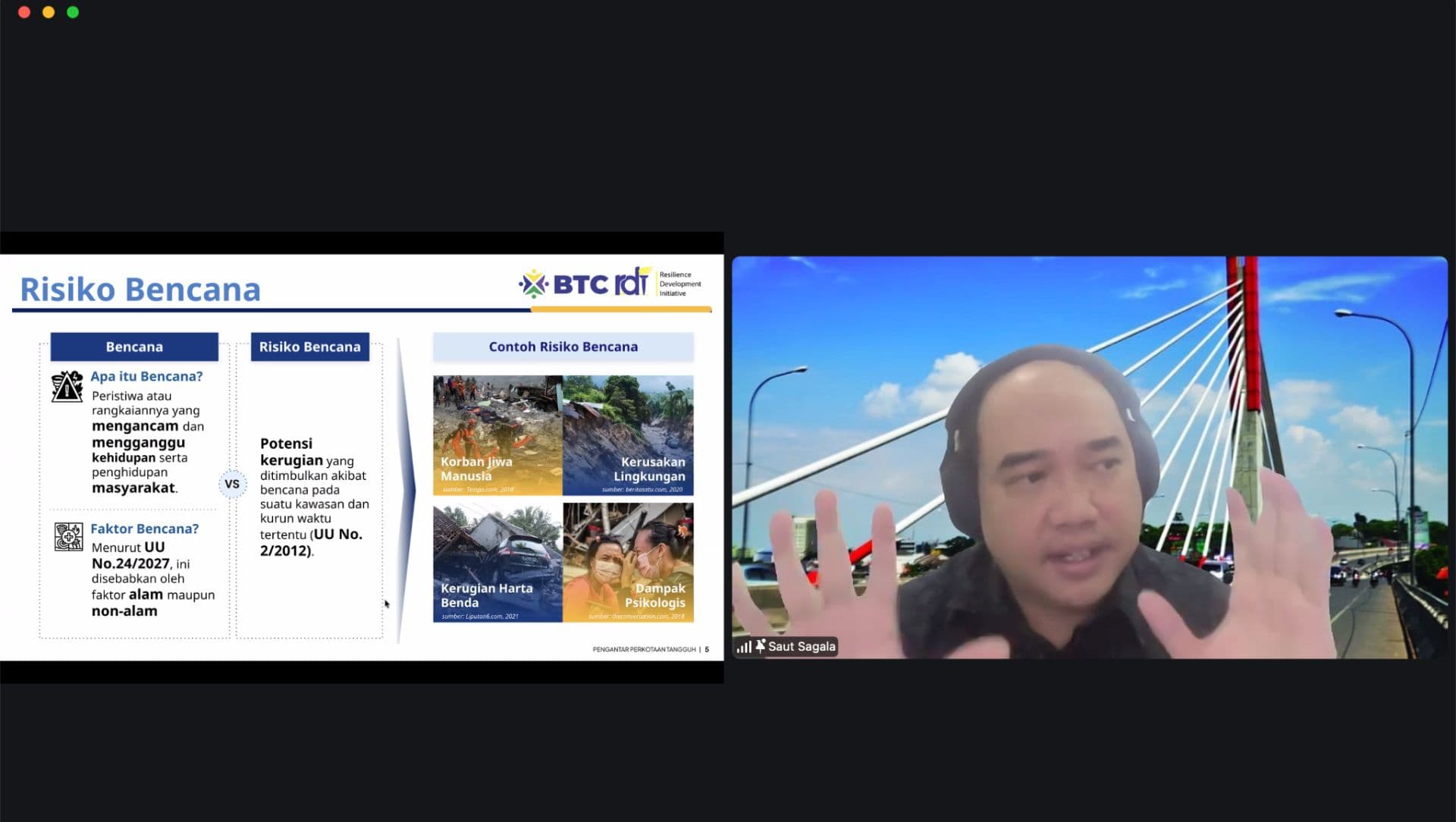
 Bandung, 3-4 August 2026 – On Monday-Tuesday, 3-4 August 2026, Baresi Training Center (BTC), the training and knowledge centre of the Resilience Development Initiative (RDI), hosted a two-day online training titled “Urban Resilience Online Course: Langkah Membangun Kota yang Adaptif dan Berkelanjutan” via Zoom Meeting. The training responded to the growing challenges posed by rapid urbanisation and intensifying climate and disaster risks, highlighting the need to develop cities that are adaptive, inclusive, and resilient in managing resources. The training brought together 20 participants, including undergraduate to doctoral students, researchers, practitioners, and other professionals working in urban resilience and related fields.
 The two-day course covered the foundations of urban disaster risk, metropolitan resilience, and the application of risk information in planning. The first day introduced key concepts of hazard, exposure, vulnerability, and community capacity, before examining urban areas as interconnected systems through the case of the Greater Jakarta (Jabodetabek) agglomeration. Participants also explored multi-criteria approaches to disaster risk assessment and strategic priority-setting, with sessions led by Dr. Saut Sagala (Global Resilience Expert, Resilience Development Initiative), Dr. Iwan Gunawan (Urban Resilience Expert, Senior Advisor PPGT Universitas Indonesia & Aurecon), and Dr. Vidya Tisandini Azizzi (Program Specialist Resilience Development Initiative).
The second day focused on translating risk knowledge into practice, covering approaches to measuring municipal resilience capacity, emergency management, and the integration of disaster risk information into spatial planning. William Harahap (Junior Expert Urban Resilience) discussed DRR through emergency management frameworks, while Azka Gunawan Hanifa(Junior Expert Urban Resilience) highlighted how land-use zoning, development control, and spatial structures can be used to reduce disaster risks.
Through these sessions, the course connected risk assessment with practical approaches to urban governance, equipping participants with tools to incorporate resilience considerations into long-term urban development and spatial planning.